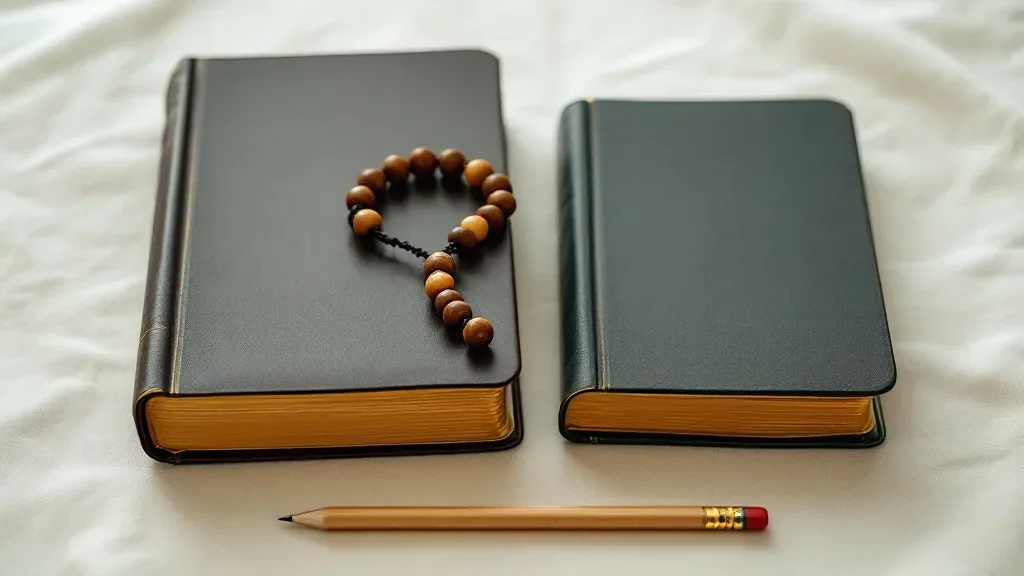
Catholic readers who want a Bible puzzle should know which translation it uses before they print it. A Catholic Bible word search hides words from a passage, so it only matches your Bible if the wording matches. Our puzzles use the King James Version.
Short answer: our Bible puzzles use the King James Version, a translation made for the Church of England. It does not match the Bible most Catholics read. They still work for passages that Catholic and other Christian Bibles share, as a personal or family puzzle. They do not work if you need the wording of the Mass readings, or puzzles from the deuterocanonical books.
A Catholic Bible word search starts with the right books
The Catechism of the Catholic Church says the canon of Scripture, the complete list of sacred books, includes 46 books for the Old Testament and 27 for the New. That makes 73 in all. The Old Testament list names Tobit, Judith, 1 and 2 Maccabees, the Wisdom of Solomon, Sirach and Baruch. These seven are usually called the deuterocanonical books.
So a Catholic Bible has books that a puzzle drawn from another Bible may never touch. Ask first which books a puzzle draws on. Passages from Genesis, the Psalms and the Gospels work in any Christian Bible. Passages from Judith or Maccabees work only in a Bible that contains those books.
Translations Catholics read, and where the KJV stands
Catholics read several English translations. Father Edward McNamara, a professor of liturgy, explained in 2006 that each country's bishops' conference chooses the translation for the liturgy, with approval from the Holy See, and that the United States uses an adapted version of the New American Bible. The revised edition of that Bible is known as the NABRE. He also wrote that "No translation is perfect."
The Douay-Rheims is the older English Catholic Bible. According to Project Gutenberg, English Catholic scholars in exile translated it from the Latin Vulgate between 1582 and 1610, and Bishop Richard Challoner revised it in the mid-1700s.
The King James Version has a different history. It was commissioned in 1604 and published in 1611 for the Church of England.
| Translation | Origin or use |
|---|---|
| Douay-Rheims | Translated from the Latin Vulgate by English Catholic scholars, 1582 to 1610 |
| New American Bible (NAB) | An adapted version is used for Mass readings in the United States |
| King James Version (KJV) | Commissioned in 1604 and published in 1611 for the Church of England |
Why the translation changes the puzzle
A word search hides words exactly as one text spells them. In our Expert level, the puzzle "Joseph's Coat Taken" prints Genesis 37:23–24 and hides the words stript, coat and colours. A translation that words the verse differently has no stript in it, so a reader with that Bible could not find the word.
Verse numbers can also differ. In a follow-up, a reader noted that Job 41:1 in the New American Bible is Job 41:9 in the King James Version. Father McNamara replied that chapters and verses were added over the centuries by scholars and printers, and that they sometimes change. A reference printed on a puzzle may therefore lead to a neighbouring verse in your Bible.
A puzzle can only hide the words that its translation uses.
What is inside our Bible verse puzzles
Each level has 40 puzzles, so the three levels hold 120. The 120 passages come from 31 books, with Genesis used 19 times, Matthew 14 times and the Psalms 11 times. Not one passage comes from Tobit, Judith, Wisdom, Sirach, Baruch or 1 and 2 Maccabees.
Every puzzle prints its passage with the reference and the label KJV. Every word to find is in that passage. The themes include the Christmas Story, Easter Morning, the Good Shepherd, Love One Another and the Sermon on the Mount. The Bible Word Search puzzles with passages from the King James Version come in three levels, Easy, Medium and Expert, and all of them are free to play or print.
Every puzzle hides only words from its own passage. Names such as Mary, Joseph and Esther appear as the passage spells them. Book names are not hidden in the grid. They appear only in the reference line. Because the wording is King James, some words use older spellings, such as SAVIOUR, COLOURS and LABOUR. A few are old forms such as KNOWETH. A reader used to the Douay-Rheims or the NABRE will meet different wording in some passages. Some words in the list will not match the Bible on their shelf.
All 120 puzzles are free, one PDF at a time, in US Letter or A4, with the answer key on page 2 and no account or email. A catechist who prints a whole level for a term can buy it as one optional print-ready PDF of 40 puzzles for $4.99. It is a convenience only, and the same puzzles stay free on the page.
Saints, sacraments and the church year
Our Bible verse puzzles have no sets about saints or the sacraments, and none follows the liturgical year, the church calendar of seasons and feasts. For those topics the site has separate free themes without Bible passages: the Catholic word search has 12 puzzles with sets such as The Seven Sacraments, The Mass and Saints, and there are Advent and Lent word searches too. Within the Bible passages, these are the nearest sets:
| Season or need | Nearest set | Level |
|---|---|---|
| Around Christmas, or the weeks before it | The Christmas Story, five puzzles from Luke and Matthew, such as "Laid in a Manger" | Easy |
| Easter | Easter Morning, five puzzles such as "He Is Risen" and "Mary Meets Her Master" | Easy |
| A prayer many Catholics know | "Our Father" in the Sermon on the Mount set | Expert |
| Lent, as a quiet theme | None labelled. Pick Sermon on the Mount or The Good Shepherd yourself | Expert, Easy |
Treat these as suggestions, not a liturgical plan. The Our Father puzzle uses King James wording, so read your own parish's version aloud before you search.
Which level to start with, and a page you can read
Pick the level for the person, not for the topic. Easy has an 8 by 8 grid with six words, hidden across and down. Medium has an 11 by 11 grid with nine words and adds diagonals. Expert has a 13 by 13 grid with twelve words in all eight directions, backwards too. If you are unsure, start with Easy. Move up when a puzzle comes back finished and the person asks for another.
The Easy and Medium grids print large on a full page. Print at "Actual size", 100 percent, and not "Fit" or "Shrink", on white paper, in good light. Print one page first and hold it where your reader sits. The King James wording is the harder part for many readers, so the wording matters as much as the grid does.
Who it suits, and using it in a class
Our Bible verse puzzles are written for adults and older readers. We do not label ages. A child who reads well can try an Easy page next to an adult, but the wording is old, so expect questions. Our kids puzzles have no Bible passages.
For a catechist or a parish class, treat the puzzle as a warm-up and not as the lesson. Look up each printed reference in your own Bible first. Then have the class read the passage aloud, search for the words, and read it again. Ask which words in the printed passage differ from the Bible on the table. That comparison is a real lesson in translation.
Where a King James puzzle fits a Catholic reader
| Use | Fit |
|---|---|
| A family puzzle on the Christmas or Easter stories | Good. The Gospels are in every Christian Bible, though the wording differs |
| A mixed group of Catholic and other Christian readers | Good. The passages are ones all of you share |
| A parish class that follows the Mass readings | Check first. The wording will differ from your lectionary |
| A puzzle on Tobit, Judith or Maccabees | Not available. We have none |
For a family evening, the story passages work well. Someone who grew up with the Douay-Rheims may find some phrases familiar and others new. Ask which wording they prefer. It starts a good conversation.
When our Bible verse puzzles are the wrong choice
If your parish or class reads from the NABRE or the Douay-Rheims and wants the puzzle to match, ours will not. We have no puzzles in those translations and none from the deuterocanonical books. If that is what you need, look for a publisher who works from a Catholic Bible and check that its passages are numbered as yours are.
We would rather say this before you print than after. All the puzzles are free, so you can open one and check the wording first, and you can compare the three levels on the Bible Word Search page.
FAQ
What are the 7 hidden books of the Bible?
They are not hidden. The Catechism of the Catholic Church lists Tobit, Judith, 1 and 2 Maccabees, Wisdom, Sirach and Baruch among the 73 books of the Catholic Bible. Our Bible puzzles do not use passages from these seven books.
Is the KJV the most accurate Bible?
We do not rank translations. A professor of liturgy wrote in 2006 that no translation is perfect. Our Bible verse puzzles use the King James Version, so compare one passage with your own Bible before you use them with a group.
Where can I find biblical word search puzzles?
Our Bible Word Search page prints a Bible passage from the King James Version on every puzzle, in three levels, Easy, Medium and Expert. Every puzzle is free to play online or print with its answer key.
Conclusion
Our Bible verse puzzles are a good fit for a family puzzle on passages that Catholic and other Christian Bibles share, and the wrong fit when you need Mass-reading wording or puzzles from the deuterocanonical books. Look up one passage in your own Bible first. If the words match closely enough for you, print on. If they do not, you have lost nothing but a few minutes.
Sources
- Vatican, Catechism of the Catholic Church, paragraph 120 on the canon of Scripture (1992) Last checked 2026-10-07.
- EWTN and ZENIT, Scriptural Translations, Fr Edward McNamara (2006) Last checked 2026-10-07.
- Project Gutenberg, The Bible, Douay-Rheims, Complete (2004) Last checked 2026-10-07.
- Project Gutenberg, The King James Version of the Bible (1989) Last checked 2026-10-07.